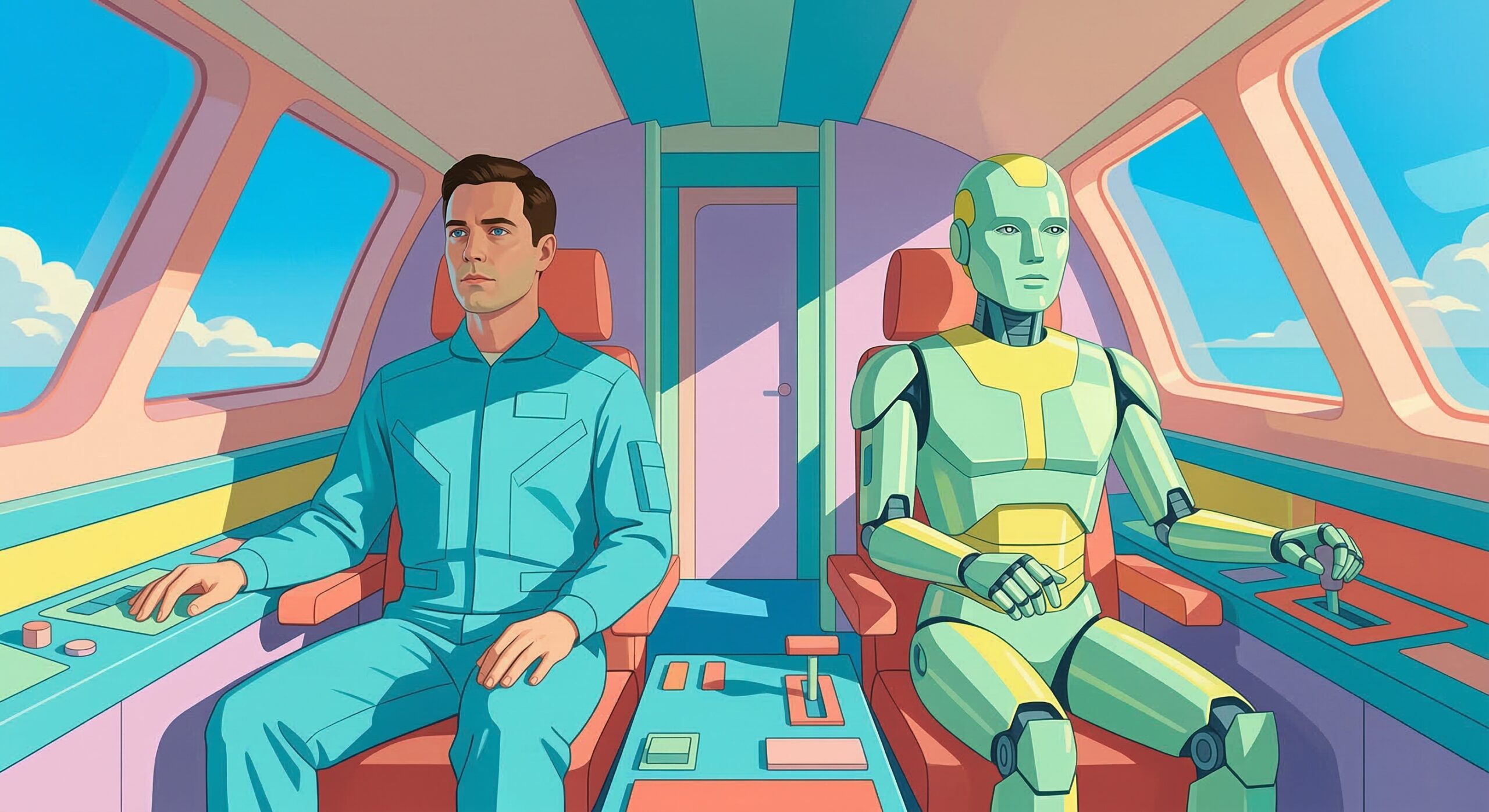
Losing the Sense of “Up” and “Down” in the Algorithmic Fog
1. The Pilot in the Clouds: What is DSD?
In aviation, there is a phenomenon known as “Spatial Disorientation.” It occurs when a pilot loses their natural sense of upright posture and position relative to the earth, often due to a lack of visual cues or intense G-forces. In the clouds, your body might tell you that you are climbing, while in reality, you are in a terminal graveyard spiral toward the ground.
In the digital realm, we are experiencing a mental equivalent of this phenomenon. I call it Digital Spatial Disorientation (DSD).
Trapped within a “fog” of overwhelming information and hyper-personalized recommender systems, we are losing the ability to distinguish between our “pure, internal thoughts” and the “externally injected noise.”
2. Micro-Manipulation: The Invisible Erosion of Choice
Modern AI does not attempt to change your mind through brute force. Instead, it slides a “recommendation” between the milliseconds of your scroll—a nudge perfectly calculated to trigger your specific interests, anxieties, and dopamine circuits.
- The Evidence (ARKS): Algorithmic bias (echo chambers) and hyper-personalized micro-targeting.
- The Process of Pollution: In that moment when you think, “I should buy this” or “I support this opinion,” is that judgment truly emerging from within? Or is it a “predetermined path” guided by fragments of information quietly placed by an AI over the past weeks?
What is even more critical is that our brains adapt to this pollution. The brain supplements even distorted information with its own context, eventually accepting it as a “normal” reality. This is exactly the same process as a pilot suffering from spatial disorientation, misperceiving a tilted aircraft as “level” and voluntarily plunging into a terminal graveyard spiral.
3. Dopamine Hacking: The Dissolution of the Self
Our neural reward systems have been effectively “debugged” and analyzed by AI. The algorithms know exactly what timing and what content will make your thumb stop, your pupils dilate, and your brain release dopamine.
When we delegate the supply of “pleasure” and “validation” to an AI, our capacity for self-determination significantly deteriorates. We begin to mistake the AI’s “pleasant correct answers” for our own “will.”
This is the ultimate crisis of DSD: the boundary between the observer and the algorithm dissolves. Like a pilot who feels a sense of weightless floating while plummeting, we are losing our sovereignty into the vast flow of the algorithm, unaware that we have even lost our way.
March 15, 2026
Yoshimichi Kumon
Organizer, LSI (Logos Sovereign Intelligence)
参照文献 / References
- Farahany, Nita A. (2023): The Battle for Your Brain. (Context for the erosion of cognitive liberty).
- LSI Research Note: “Defining Digital Spatial Disorientation (DSD) in High-Dimensional Information Environments” (March 2026).
- MIT Media Lab: “The Impact of Algorithmic Curation on Human Agency” (Foundational research for DSD).
- Keyes, Daniel (1966): Flowers for Algernon. (Philosophical context for the atrophy of native intelligence).


Ⅽomment