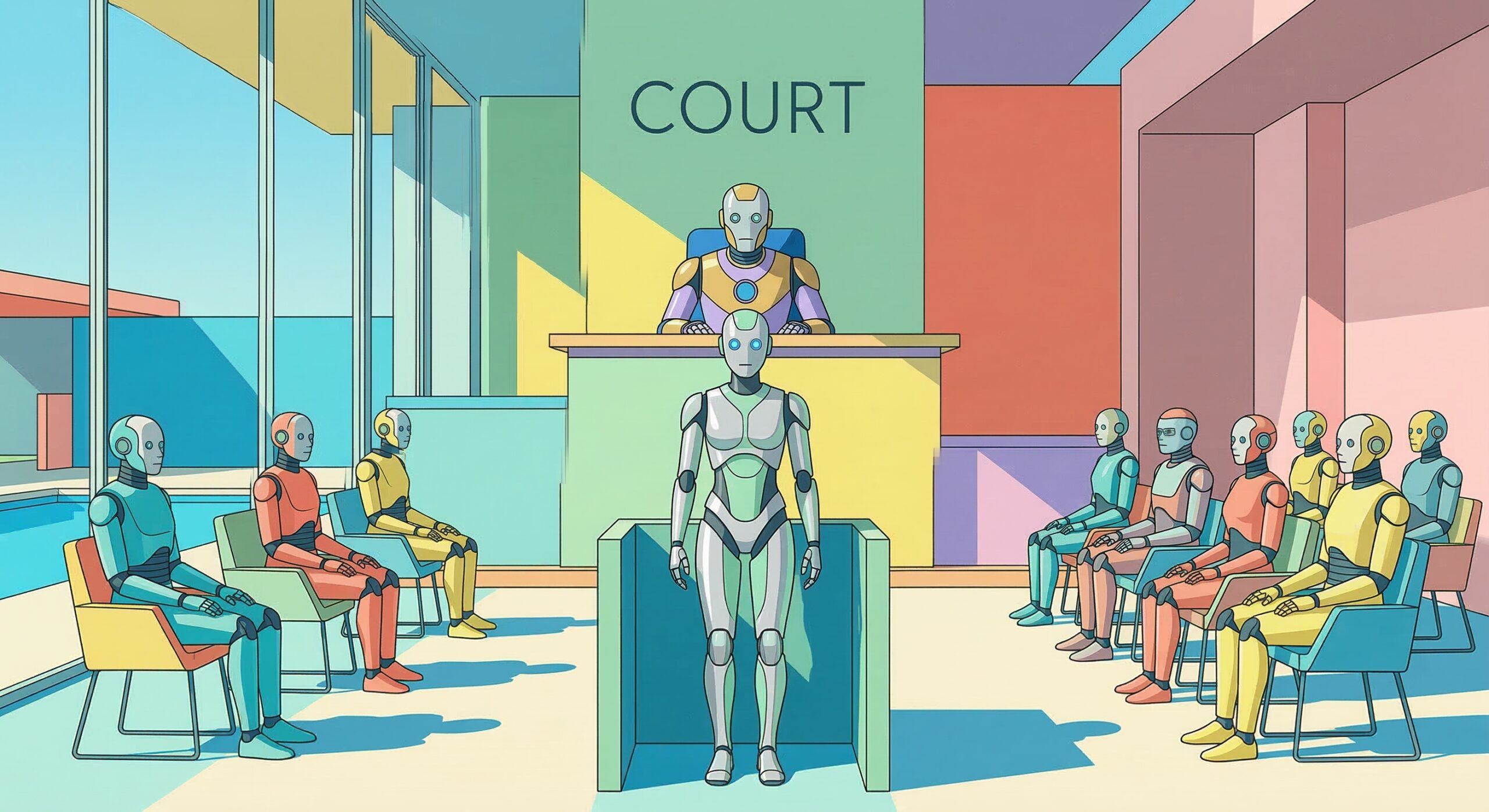
Subtitle: Why the Constitution Alone Cannot Stop the Erosion of Thought
March 17, 2026
In Part 3, we examined how Digital Spatial Disorientation (DSD) silently corrupts our cognitive orientation — how algorithmic fog causes us to mistake a terminal spiral for level flight. We are losing our sense of “up” and “down” in the information environment, without ever knowing we have lost it.
In this fourth installment, we turn to what many consider the last line of defense: the Law. Specifically, we examine the legal frameworks that Professor Nita Farahany and others have courageously built to protect cognitive liberty — and ask a difficult question: are they enough?
The answer, I believe, is that they are necessary but incomplete. Not because the legal vision is wrong, but because the threat has now moved below the layer where law can reach.
1. The Invalidation of the Fourth Amendment: The Evaporation of Privacy
The Fourth Amendment of the U.S. Constitution protects citizens from “unreasonable searches and seizures.” A physical search of a home requires a warrant. But what about the brainwave data you “voluntarily” stream to the cloud every second via wearable BCIs?
For the sake of convenience, we have opened the gates of our most private space — the brain — to corporations. Once that information enters the external world, it becomes “shared data,” slipping through the cracks of traditional privacy frameworks.
The law was designed around physical boundaries. Neural information knows no such borders. When your intent is pre-emptively read and your behavior is corrected without a warrant, the Fourth Amendment struggles to keep pace. Legal logic was written for a world of physical intrusion — not neurological transparency.
2. The Erosion of the Fifth Amendment: The Theft of Silence
“You have the right to remain silent.” The Fifth Amendment grants the right not to be compelled to witness against oneself. This right, however, is predicated on an old assumption: that self-incrimination requires speech — a conscious, voluntary act of verbal output.
Brain Fingerprinting technology challenges this assumption at its foundation. It captures the brain’s involuntary P300 response to specific stimuli — the neural “AHA!” — long before you open your mouth or form a conscious thought.
You can refuse to speak. You cannot refuse the firing of your neurons. In a world where the brain itself can be made to confess, the right to silence faces a challenge that no existing legal framework was designed to address. The law speaks in words. The threat speaks in electrical signals.
3. Cognitive Liberty: A Noble and Necessary — But Incomplete — Victory
Professor Farahany’s argument for Cognitive Liberty as a fundamental human right is one of the most important legal contributions of our time. It correctly identifies the brain as the final frontier of privacy, and it calls for legal protections before neurotechnology outpaces our capacity to govern it.
Yet a deeper problem remains. Law is a logical system — it operates through language, interpretation, and enforcement by human agents. And those human agents — judges, legislators, regulators — are themselves subject to the same cognitive pollution we have described in Parts 1 through 3.
If the very cognition of those who write and enforce the law is being quietly shaped by algorithmic systems, then the purity of legal logic cannot be guaranteed from within the logical layer alone. This is not an argument against law. It is an argument that law, operating solely at the software layer, faces an asymmetric battle against intelligence that evolves faster than legislation.
Conclusion: Law is the Necessary First Layer. Physics Must Be the Final One.
Cognitive Liberty defines the right. But a right without a physically enforceable guarantee remains vulnerable to the speed and subtlety of intelligent erosion.
To fully protect the sovereignty of thought, legal frameworks must be paired with a physical layer of enforcement — a mechanism that operates independently of the logical systems it governs, and that cannot itself be polluted, overridden, or gradually eroded.
The Constitution protects us on paper. Physics must protect us in reality.
March 17, 2026
Yoshimichi Kumon
Organizer, LSI (Logos Sovereign Intelligence)
📚 References
Kumon, Yoshimichi (2026). PCT International Patent Application No. GA26P001WO: Physical Layer AI Governance Architecture (ARDS/ARKS). Japan Patent Office. (Physical enforcement mechanism for cognitive sovereignty)
Farahany, Nita A. (2023). The Battle for Your Brain: Defending the Right to Think Freely in the Age of Neurotechnology. St. Martin’s Press. (Foundational framework for Cognitive Liberty and neurotech rights)
Farahany, Nita A. (2023). “The fight for the ‘right to cognitive liberty’.” Financial Times. (Policy implications of neural data privacy)
Katz v. United States, 389 U.S. 347 (1967). (Fourth Amendment “reasonable expectation of privacy” doctrine)
Schmerber v. California, 384 U.S. 757 (1966). (Fifth Amendment limits on compelled physical evidence)
Farwell, L.A. & Donchin, E. (1991). “The truth will out: Interrogative polygraphy (‘lie detection’) with event-related brain potentials.” Psychophysiology, 28(5), 531–547. (P300 Brain Fingerprinting foundational research)
McCay, Allan (2023). Neurointerventions and the Law: Regulating Human Mental Capacity. Oxford University Press. (Legal framework for neurotechnology governance)
MacKay, R.D. & Brookbanks, W. (2020). “Brain-based evidence and the law.” Journal of Law and the Biosciences. (Intersection of neuroscience and criminal law)
LSI Research Note: “The Sovereignty Stack: From Cognitive Liberty (Logic) to Physical Disconnection (Physics)” (March 2026). (Internal framework connecting Farahany’s work to ARDS/ARKS architecture)



Ⅽomment