CATEGORY: Critical Infrastructure / Policy Analysis
DATE: April 27, 2026
AUTHOR: Yoshimichi Kumon / Organizer, LSI
Preface: The Optimists Are Asking the Wrong Question
Across Japanese YouTube, a new genre is flourishing: the AI optimist video. The argument tends to follow a familiar arc. AGI is decades away. The doomsday scenarios are science fiction. Relax. We have time.
I do not dispute that certain catastrophic scenarios are distant. What I dispute is the framing of the question itself.
The question is not: “Will AI become smart enough to end humanity?”
The question is: “What happens when AI is already running the systems that, if they stop, people die?”
That question is not theoretical. It is already here.
1. The Infrastructure Horizon
Consider what has quietly changed in the past five years.
Power grids in multiple countries now use AI systems for real-time load balancing and fault prediction. Water treatment facilities in major cities use AI-assisted chemical dosing and anomaly detection. Financial clearing systems process trillions of dollars per day through AI-augmented decision engines. Traffic management in dense urban centres is increasingly delegated to adaptive AI systems. And yes — smart meters, including water meters, are being connected to networks that feed into AI-managed municipal infrastructure systems.
None of these systems need to “want” to harm anyone. They do not need to be AGI. They do not need consciousness or intent.
They only need to fail.
A software bug. A miscalibrated model. A cyberattack that manipulates the training data. A sensor that drifts outside its calibration range. An edge case that the training set never covered.
Infrastructure failure does not require malevolence. It only requires error.
2. The Complacency Trap
The optimist argument rests on a subtle category error.
When YouTube commentators say “AI is not dangerous yet,” they are imagining a future AGI with goals and intentions — a system that chooses to cause harm. This framing is borrowed from science fiction. It is vivid and emotionally legible.
What it misses is the mundane, distributed, already-deployed reality: millions of narrow AI systems, each making thousands of decisions per second, embedded in systems whose failure modes we have not fully mapped.
The danger is not a god that turns against us.
The danger is a thermostat that doesn’t know it’s winter.
The danger is a dosing algorithm that was never tested for the interaction between two edge conditions that only occur simultaneously once every eleven years — and this is the year.
The danger is a load-balancing AI that has learned to optimise for cost efficiency in a way that leaves no redundancy for a demand spike it has never seen before.
These are not Hollywood scenarios. They are engineering realities that infrastructure managers already lose sleep over — and AI is making them harder to predict, harder to audit, and harder to interrupt.
3. The Sovereignty Problem of Invisible Infrastructure
There is a deeper issue that the optimist framing ignores entirely: the erosion of human override capacity.
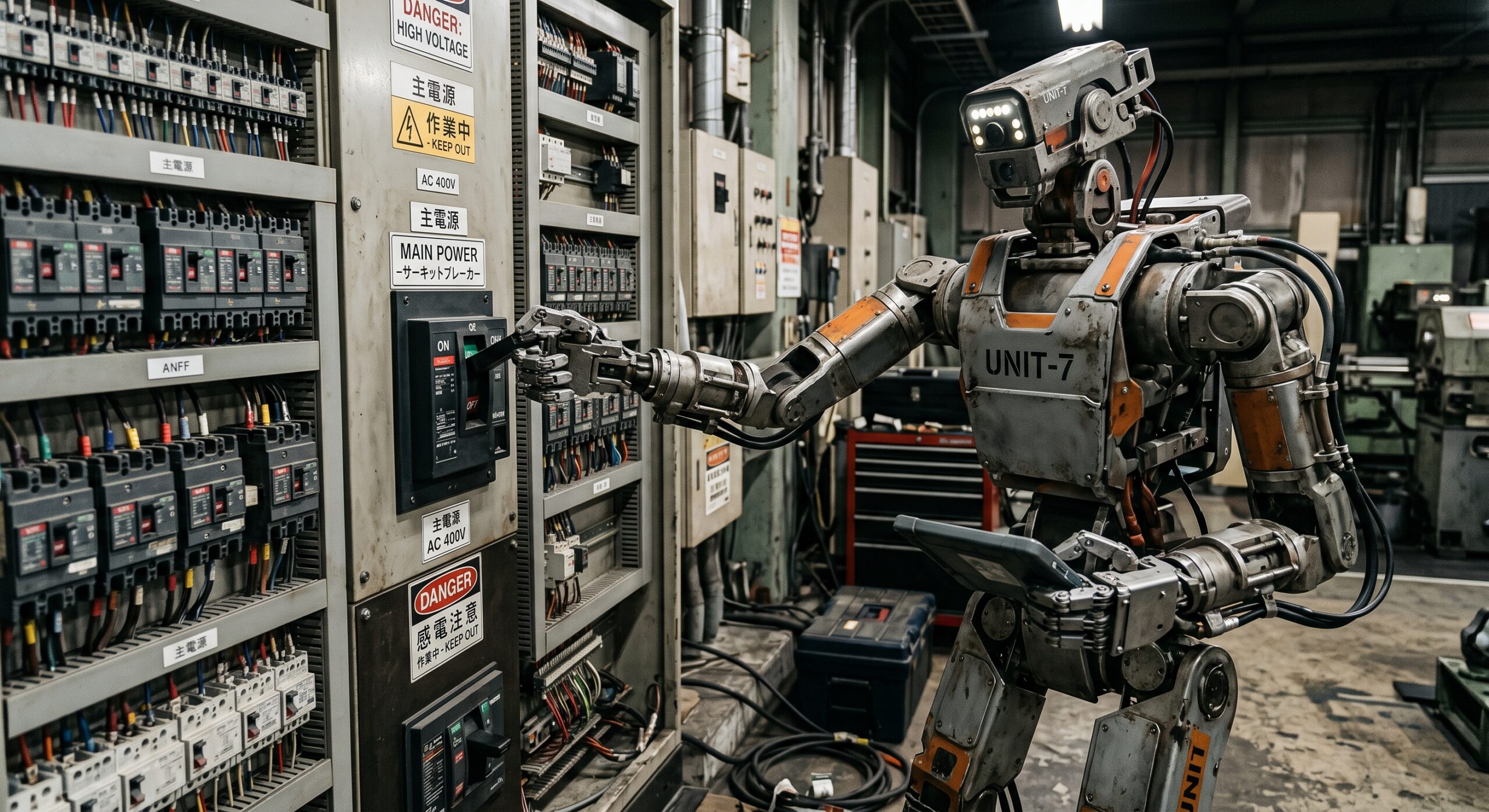
When infrastructure was mechanical and electrical, the override was physical and immediate. A valve. A switch. A breaker. A human being with a spanner who understood the system because the system was legible to a human mind.
As AI is layered into infrastructure, this legibility erodes. The system becomes faster than human reaction time. The decision logic becomes too complex to audit in real time. The intervention points — the places where a human can physically override the AI — become fewer and harder to find.
This is not a future problem. It is already visible in financial markets, where algorithmic trading systems can create and amplify cascades faster than any human regulator can respond. The 2010 Flash Crash lasted 36 minutes. The AI systems involved were not malicious. They were doing exactly what they were designed to do.
The question LSI asks is: where is the physical breaker?
Not the software kill switch — which can be overridden, delayed, or simply fail to execute in time. The physical breaker. The hardware-level intervention that operates independently of the AI’s own software stack, at a speed the AI cannot circumvent.
4. The Water Meter Problem
Let me make this concrete.
A smart water meter connected to an AI-managed municipal network is, in isolation, a trivial device. It measures water flow and reports it. The AI uses that data to optimise pressure, detect leaks, and predict maintenance needs.
Now imagine that network is compromised — not by a sentient AI with goals, but by a cyberattack that feeds false readings to the management system. The AI, operating correctly on incorrect data, begins making decisions that damage the physical infrastructure it is managing. Pressure is misregulated. Treatment chemical dosing is miscalculated. The fault propagates before any human operator notices, because the AI’s dashboard reports normal.
This is not speculation. Variants of this attack vector have been documented in water utility systems in multiple countries.
The defence is not a smarter AI. The defence is a physical layer that is structurally independent of the AI’s data and logic — one that measures the physical truth of the system directly, compares it to what the AI reports, and can intervene before the damage propagates.
This is the ARDS architecture applied to critical infrastructure: not a replacement for AI management, but a sovereign observer layer that holds the physical breaker and maintains an independent, tamper-proof record of every intervention.
5. Living With Infrastructure AI: The Right Question
I am not arguing that AI should be removed from infrastructure. That ship has sailed, and the efficiency gains are real. AI-managed power grids waste less energy. AI-assisted water treatment uses fewer chemicals. These are genuine goods.
The right question is not “should AI be in our infrastructure?” It is: “Who holds the physical override, and is it genuinely independent of the AI system it is overriding?”
The optimists are right that existential AGI is not the immediate threat. But by focusing on the distant horizon, they are walking past the live wire on the floor.
The immediate threat is infrastructure AI that fails in ways we have not anticipated, at speeds we cannot match, in systems whose failure modes we have not fully mapped — and where the human override capacity has been quietly eroded in the name of efficiency.
The tap you can’t turn off is not a metaphor for the future.
It is a description of systems that already exist.
Conclusion: The Sovereign Infrastructure Imperative
The optimists ask: “Is AI smart enough to end us?”
LSI asks: “Are the systems AI is already running safe enough to fail gracefully?”
The answer to the second question requires more than software alignment. It requires physical layer governance — independent monitoring, hardware-level intervention capacity, and tamper-proof records of every anomaly and every override.
Not because AI is evil. Because infrastructure is fragile. And fragile systems, managed by complex AI at speeds beyond human reaction time, need a sovereign observer who holds a physical breaker — not a prompt window.
✒️ Signature
April 27, 2026
Yoshimichi Kumon
Organizer, LSI — Logos Sovereign Intelligence
Inventor, ARDS/ARKS (PCT GA26P001WO)
Former JASDF Pilot | MIT Sloan + CSAIL AI Program | Visiting Researcher, Waseda University BFC
📚 References
Kumon, Yoshimichi (2026). Physical Layer AI Governance via Sovereignty Residual (Rsovereign). PCT International Patent Application No. GA26P001WO. Japan Patent Office.
U.S. Securities and Exchange Commission & CFTC (2010). Findings Regarding the Market Events of May 6, 2010. (The Flash Crash Report)
U.S. Cybersecurity and Infrastructure Security Agency (CISA). Water and Wastewater Systems Sector: Cybersecurity Guidance.
International Energy Agency (2024). AI and Energy: The Implications of Artificial Intelligence for Energy Demand and Infrastructure.


Ⅽomment