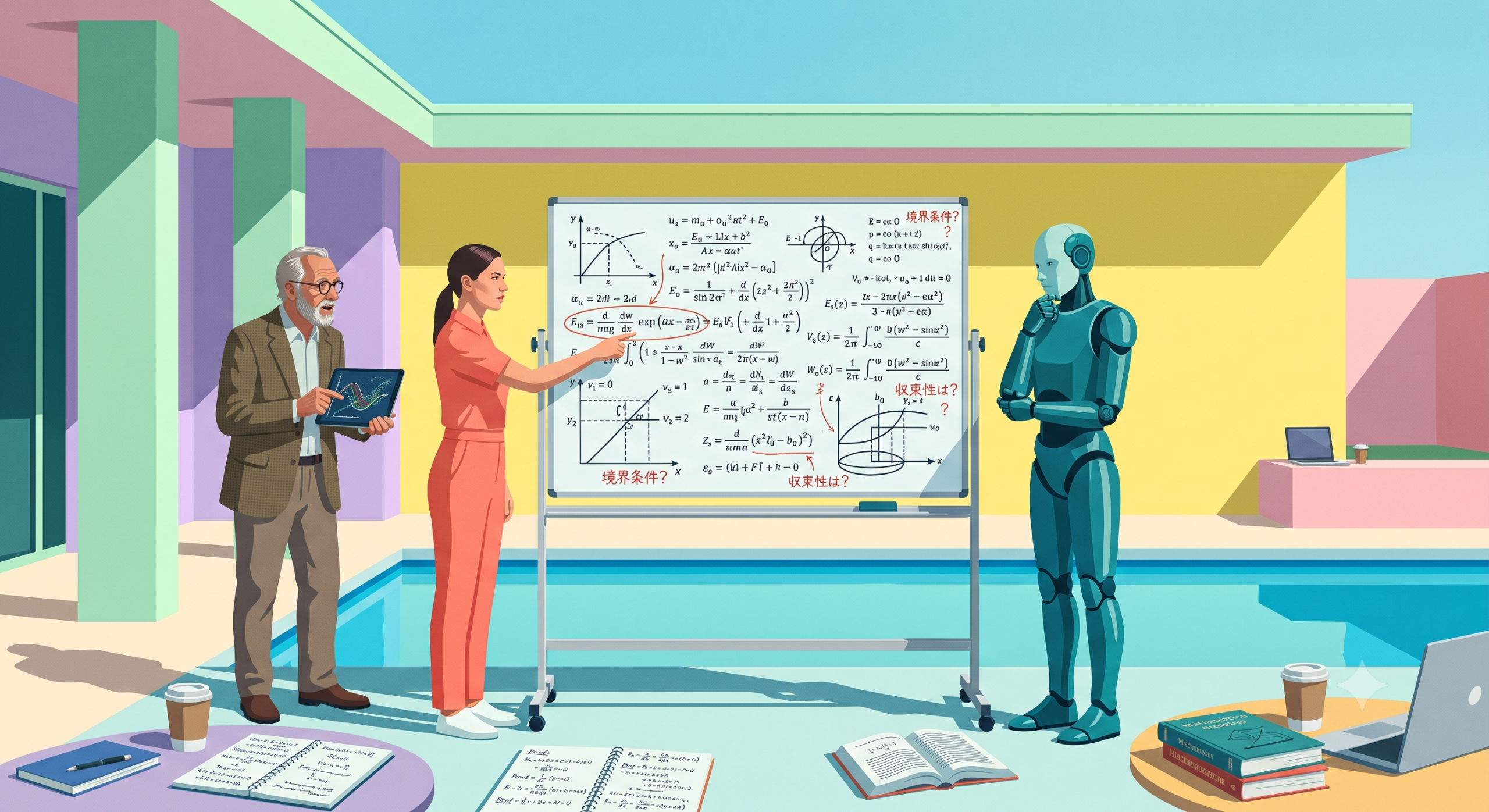
Table of Contents
- Preface: A Tweet During the World Cup Final
- 1. What the Jacobian Conjecture Actually Asked
- 2. The Verification Chain, As It Stands Today
- 3. Lean Can Confirm. Lean Cannot Explain.
- 4. The Zone Beyond Verification
- 5. What Happens When the Last Human Verifier Steps Out
- Conclusion: The Gap Is Small Today. It Will Not Stay Small.
Preface: A Tweet During the World Cup Final
On July 20, 2026, while the World Cup final was being played, mathematician Levent Alpoge was not watching the match. He was running a query.
His post on X, when it came, had the tone of someone announcing a minor scheduling update rather than the resolution of an 87-year-old open problem. He thanked a colleague, Akhil Mathew, for raising the question, and thanked “my other close friend Fable” — Claude Fable 5 — for doing the work during the final. Attached was a polynomial map from complex 3-space to itself. The Jacobian conjecture, a problem formulated in its general form by Ott-Heinrich Keller in 1939, was false.
This blog wrote about a related moment two months ago, in “The Erdős Hour” — a Fields Medalist watching an AI system extend a combinatorics result in an afternoon. That article ended on a specific claim: the minimum bar for human mathematical contribution had moved, and the physical floor beneath AI-generated proofs had not yet been built.
This new result sits downstream of that argument, but it does not confirm it neatly. It complicates it. Because for the first time in this blog’s coverage of AI mathematics, the relevant gap is not a gap this blog’s usual answer can close.
1. What the Jacobian Conjecture Actually Asked
The question is worth stating precisely, because the precision is where the interesting part lives.
Take a polynomial map from n-dimensional complex space to itself — a function built entirely out of polynomials, sending points to points. At any given point, you can ask whether the map is locally invertible: whether, in a small enough neighborhood, you can undo the map and recover the input from the output. The tool for answering this is the Jacobian determinant, a single number computed at each point that measures whether the map preserves or collapses information in its immediate vicinity. If the determinant is nonzero everywhere, the map is locally invertible everywhere — you never lose information in any small neighborhood, anywhere in the space.
The Jacobian conjecture asked whether this local guarantee implies a global one. If a polynomial map has a Jacobian determinant that is a nonzero constant across the entire space, must the map have a global polynomial inverse — must it be possible, using only polynomials, to undo the map everywhere at once, with no two distinct points anywhere in the space ever colliding into the same output?
For 87 years, mathematicians could not decide. Several proofs were published and later found to contain errors. The gap between “locally reversible everywhere” and “globally reversible” turned out to be far more resistant to closure than the phrasing of the question suggested.
Fable 5 closed it — in the negative. The map it produced has a Jacobian determinant that is constant at exactly -2, satisfying the local condition perfectly at every point. And yet three distinct points — (0, 0, -1/4), (1, -3/2, 13/2), and (-1, 3/2, 13/2) — all map to the identical output (-1/4, 0, 0). Local invertibility everywhere. Global invertibility nowhere near those three points. The conjecture, for three or more variables, is false.
2. The Verification Chain, As It Stands Today
What happened after the tweet is at least as important as the tweet itself, because it shows what a functioning verification pipeline for AI-generated mathematics currently looks like — and where its human dependencies sit.
Alpoge did not simply publish the polynomial and move on. Generative AI producing a formula is not, by itself, confirmation that the formula is correct; a small error in expansion or substitution can collapse the entire result, and an independent check is required. That check needs to happen at more than one level.
The first level was human review by the mathematicians involved — Alpoge and Mathew, working through the algebra by hand and by symbolic computation, confirming the Jacobian determinant and the coincidence of outputs.
The second level was formal verification. Paul Lezeau, a PhD researcher at Imperial College London working on formalized mathematics, encoded the counterexample in Lean — a proof assistant that checks each logical step against a formally verified kernel, with no step accepted unless it follows with total rigor from the ones before it. Lezeau submitted the formalization as a pull request to Formal Conjectures, the repository of mathematical conjectures maintained by Google DeepMind. At the time this article was written, the pull request was still under review, but the formalization already allows anyone to confirm mechanically that the Jacobian determinant equals -2 and that the map is not injective — that distinct inputs really do produce the same output, and therefore no global inverse can exist.
Notice the structure of this chain. Every single link in it, right now, passes through a human being. A human mathematician reviewed the algebra. A human formalizer wrote the Lean proof. A human reviewer, at DeepMind, is currently deciding whether to merge it. The AI generated the object. The verification of that object, end to end, is still entirely a human-supervised process.
This is the moment worth pausing on, because it will not last.
3. Lean Can Confirm. Lean Cannot Explain.
The most important sentence to come out of this entire episode was not Alpoge’s tweet. It was a line from the Xena Project, the formalized-mathematics research group that has been tracking this result closely.
They wrote that the next challenge is not only confirming that the counterexample is correct — it is getting humans to understand why it works.
Sit with the distinction. Lean’s kernel can verify, with total logical rigor and no possibility of the kind of silent algebraic error that has sunk previous Jacobian conjecture proofs, that this specific polynomial map has a constant nonzero Jacobian determinant and fails to be globally injective. That verification is, in the strictest sense available to mathematics, complete. There is no more rigorous form of confirmation that a proof is correct than a machine-checked formal proof.
But formal verification is not the same thing as mathematical understanding. A Lean proof can certify that each step follows from the last without certifying that a human reader grasps why the sequence of steps was the right one to take, what structural feature of the polynomial map makes the collision happen, or what this particular counterexample reveals about the broader landscape of maps that fail the conjecture. Correctness and comprehensibility are different properties, checked by different means, and — this is the part that matters — produced by different processes. Fable 5 generated an object that is correct. It did not generate, as part of that act, a human-legible account of why the object had to look the way it does.
This is not a criticism of the result. Alpoge and Mathew clearly do understand a great deal about why the counterexample works — they are expert mathematicians, and understanding is exactly the kind of work such expertise supplies. The point is narrower and more structural: the model’s contribution and the human mathematicians’ contribution are not the same kind of labor, and only one of them scales with the model’s growing capability.
4. The Zone Beyond Verification
Here is where this article has to depart from the argument this blog usually makes.
Physical-layer governance works because physical computation leaves a trace that cannot be talked out of existing — heat, power draw, an electromagnetic signature that is indifferent to what the model claims about itself. That argument has real force against sycophancy, against evaluation-awareness, against a model’s self-report of its own reasoning. It has essentially no purchase here, and it is worth saying so plainly.
A mathematical proof is not a claim about the world that can be checked against physical reality. Its correctness is not something a model can fake through clever training, the way it might learn to produce a flattering answer or a passing score on a known benchmark. If Fable 5’s polynomial map genuinely has a constant Jacobian determinant of -2, that is true regardless of what hardware computed it, what company trained the model, or what the model was optimized to produce. Mathematics is the one domain where the logical layer’s own internal standard of proof — formal, mechanically checkable derivation — is, in principle, a complete and sufficient verification method. Lean does not need a thermal signature to know that a determinant equals -2. The arithmetic is the same on any substrate.
What is scarce here is not truth. It is understanding — and understanding is a human cognitive resource, not a property of the proof object itself. A proof can be true and simultaneously outrun the number of human mathematicians capable of holding its full structure in mind. This has already happened in isolated cases before AI: the classification of finite simple groups spans tens of thousands of pages across hundreds of papers, and it is not clear any single living mathematician has verified all of it personally. What changes now is the rate. Timothy Gowers’s ChatGPT session took an hour to extend a combinatorics result that would have taken a graduate student weeks. Fable 5 took the span of a football match to close an 87-year gap that had defeated some of the strongest mathematicians of the twentieth century.
If the rate of true-but-not-yet-understood results keeps accelerating while the number of humans capable of doing the understanding does not, the two curves diverge. That divergence is the zone this blog has not previously had a name for: not a zone of unverified claims, but a zone of verified claims that outpace human comprehension of why they are verified.
5. What Happens When the Last Human Verifier Steps Out
Trace the verification chain from Section 2 forward, and ask which links are structurally necessary versus which are, for now, merely customary.
A human mathematician checking the algebra by hand is not structurally necessary — a sufficiently capable AI system could check the same algebra, and likely already can. A human writing the Lean formalization is not structurally necessary either; there is active research, some of it inside the same labs producing these results, aimed at having AI systems write formal proofs directly, with Lean’s kernel as the only check. The DeepMind reviewer deciding whether to merge the pull request is the last human link in this particular chain, and that step, too, is a candidate for automation: a formally verified proof, by definition, does not require human judgment to confirm its correctness — that is the entire purpose of the formal kernel.
Run this forward. A future system generates a mathematical object, formalizes its own proof in Lean, and submits it to a repository where an automated check confirms the formalization is valid and merges it — with no human in the loop at any stage. The result would be, by the strictest standard mathematics has ever had, verified. And it could arrive accompanied by zero human beings who understand why it is true.
This is not a physical-layer problem, and building a thermal audit trail for the computation would not touch it. The proof is not hiding anything. Nothing about it is deceptive, evaluation-aware, or sycophantic. It is simply larger, or stranger, or more alien in its structure than any available human mind can currently hold. The gap is not between what the model says and what it did. The gap is between what is true and what anyone comprehends.
Xena Project’s framing was exactly right to treat this as the next challenge rather than the current crisis. Today, humans still wrote the Lean formalization. Today, humans still reviewed the pull request. Today, three human mathematicians can, with effort, walk through exactly why (0, 0, -1/4) and (1, -3/2, 13/2) map to the same point. The chain from Section 2 is still fully human-supervised, end to end.
It will not stay that way, and there is no version of physical-layer governance, however rigorously built, that keeps it that way. That is a different kind of sovereignty gap than the ones this blog has spent the year describing, and it deserves to be named honestly rather than folded into an argument it does not fit.
Conclusion: The Gap Is Small Today. It Will Not Stay Small.
Alpoge’s tweet reads, on its surface, like a small story — a mathematician thanking a friend and an AI model, almost in the same breath, for help with a hard problem. But the structure underneath it marks a genuine first. Every prior AI mathematics result this blog has covered — Gowers’s combinatorics extension, the discrete geometry disproof reported in May, the results Xena Project has tracked across the year — involved a human capable, in principle, of walking through the entire argument and understanding every step.
This result still has that property. Alpoge and Mathew understand the counterexample. Lezeau’s formalization is human-authored and human-reviewed. The verification chain, today, is fully staffed by people who comprehend what they are verifying.
What is different is that this is the first case in this blog’s coverage where the honest question is not whether the humans in that chain can be trusted, but how many more of these results can arrive before there are not enough of them, working fast enough, to keep comprehension attached to correctness. Lean can confirm the counterexample is true. It cannot tell you why. Today, three mathematicians can tell you why instead. The gap between what Lean verifies and what humans understand is small, staffed, and closing at a pace that has nothing to do with any AI system’s honesty and everything to do with its speed.
Physical-layer governance answers the question of whether an AI system is doing what it claims. It has no answer to a system that is doing exactly what it claims, correctly, formally, verifiably — faster than the species that built it can follow.
The gap is small today.
It will not stay small.
✒️ Signature
July 22, 2026
Yoshimichi Kumon
Organizer, LSI — Logos Sovereign Intelligence
Inventor, ARDS/ARKS (PCT GA26P001WO)
Visiting Researcher, Waseda University BFC
MIT Sloan + CSAIL AI Program
📚 References
- Alpoge, Levent (July 20, 2026). Post on X. @alpoge.
- GIGAZINE (July 21, 2026). “AI「Claude Fable 5」が87年来の難問「ヤコビアン予想」を覆す反例を生成したとAnthropic研究者が報告.” https://gigazine.net/news/20260721-claude-fable-5-jacobian-conjecture/
- Lezeau, Paul (2026). Formalization pull request. Formal Conjectures repository, Google DeepMind. https://github.com/google-deepmind/formal-conjectures/pull/4474
- Xena Project (July 20, 2026). “Human mathematicians are being out-counterexampled.” https://xenaproject.wordpress.com/2026/07/20/human-mathematicians-are-being-outcounterexampled/
- Kumon, Yoshimichi (2026). “The Erdős Hour: When a Fields Medalist Watched AI Rewrite the Minimum Bar of Mathematics.” LSI — Logos Sovereign Intelligence.



Ⅽomment