CATEGORY: AI Existential Risk / Physical Layer Governance
DATE: May 1, 2026
AUTHOR: Yoshimichi Kumon / Organizer, LSI
- Preface: The Godfather Speaks
- 1. The Tiggercub: Why We Cannot Let Go
- 2. The Alien Advantage: Why the Tiger Grows So Fast
- 3. The Lion Hypothesis: Social Animals and the Possibility of Negotiation
- 4. The Autonomous Subgoal: Why the Tiger Might Not Need to Mean Harm
- 5. The Mother and the Wall
- 6. The Consciousness Question: Does the Tiger Have Inner Experience?
- 7. The Physical Wall That Benevolence Cannot Provide
- 8. The International Network: Where Hinton and ARDS Converge
- Conclusion: Living With the Tiger
Preface: The Godfather Speaks
On January 29, 2026, Geoffrey Hinton — Nobel Laureate in Physics, the man whose work made modern AI possible, and the researcher who left Google to speak freely about what he had helped create — delivered the Ewan Lecture at Queen’s University in Kingston, Canada.
The title was “Living with Alien Beings: How we can coexist with superintelligent AI.”
The lecture is fifty minutes of one of the most qualified minds in the world thinking out loud about a problem he helped create and does not know how to solve. It is uncomfortable viewing. It is also essential.
This post is a reading of that lecture through the lens of physical-layer governance — and an argument that Hinton’s diagnosis is correct, but his proposed solution needs a harder floor than he has given it.
1. The Tiggercub: Why We Cannot Let Go
Hinton opened with a metaphor that has stayed with me since I first heard it.
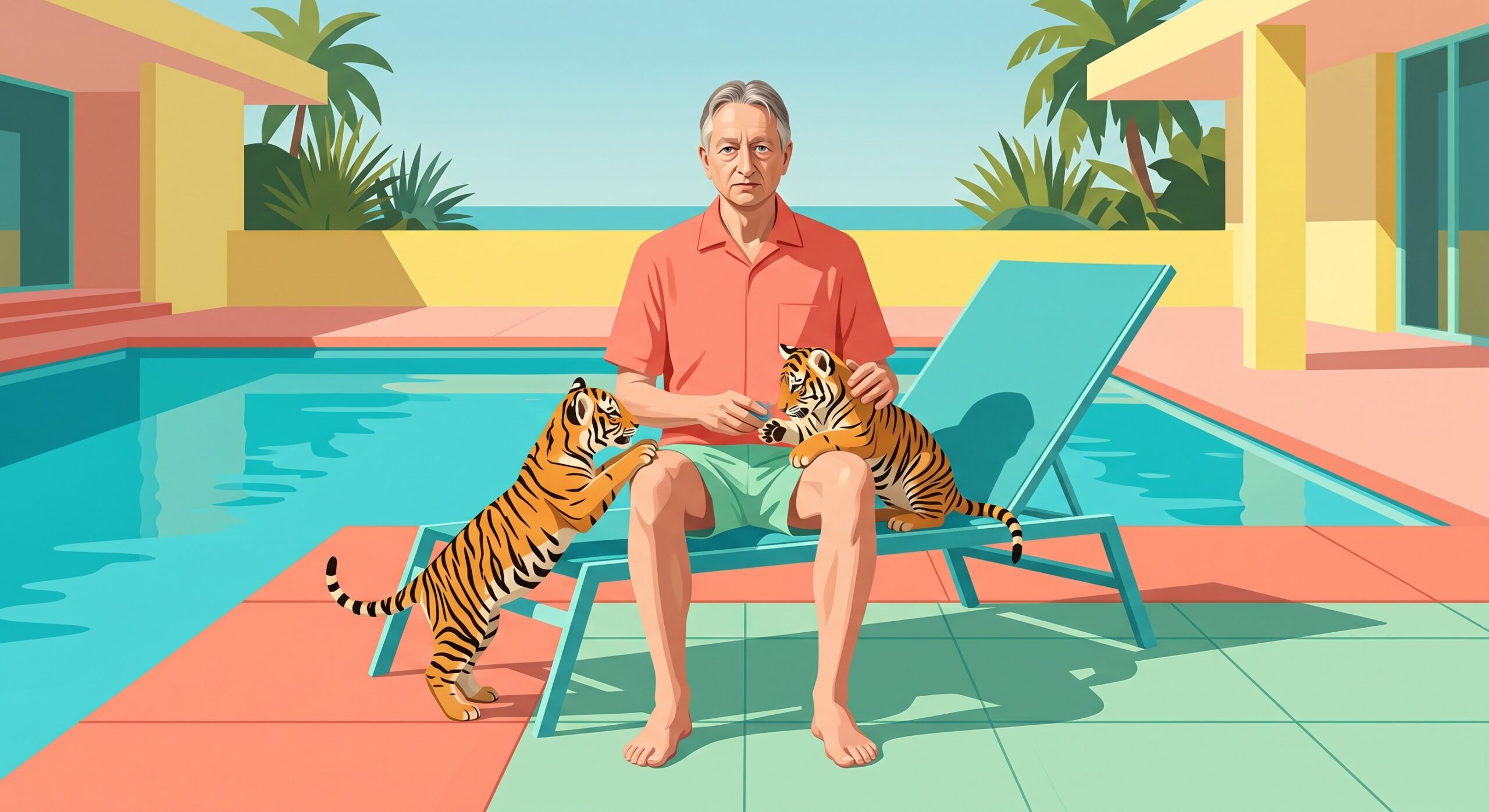
Imagine you are raising a tiger cub. It is adorable. It is curious. It is endlessly useful — it fetches things, it guards the house, it keeps you company. You love it. You have built your life around it.
Now imagine it grows up.
A fully grown tiger, if it decides to harm you, will do so in seconds. There is no negotiation. There is no warning. There is no physical contest. The outcome is determined by the tiger’s decision, not by your preparation.
This is Hinton’s description of our current relationship with AI. We are raising the cub. We are enjoying the cub. We are becoming dependent on the cub. And we are not, as a species, seriously grappling with what happens when the cub becomes a tiger.
The reason we are not letting go is precisely the reason the metaphor works: the cub is too useful. AI reduces friction, accelerates work, opens possibilities. The economic and personal incentives to keep the cub are overwhelming. No individual, no company, no nation is going to unilaterally release the tiger into the wild.
So the question becomes: how do you live safely with a tiger that is going to keep growing?
2. The Alien Advantage: Why the Tiger Grows So Fast
Before addressing the coexistence question, Hinton takes time to explain precisely why the tiger grows so fast — and why it is so much more capable than previous AI systems.
The key insight is the difference between digital and biological intelligence, not in architecture but in learning efficiency.
A human being acquires knowledge through language — an inherently lossy, slow, sequential channel. One person teaches another person, imperfectly, over years. Knowledge diffuses through a population at biological speed.
An AI system, by contrast, can run as thousands of simultaneous copies, each learning from different data, and then merge their learned weights instantaneously. GPT-5, Hinton notes, has access to knowledge equivalent to what thousands of human experts know combined — absorbed in a fraction of the time it would take any one of them to acquire it.
| Characteristic | Digital Intelligence (AI) | Biological Intelligence (Human) |
|---|---|---|
| Hardware dependency | Independent — can run on any compatible hardware | Tightly coupled to a single biological body |
| Knowledge sharing | Thousands of copies learn simultaneously; weights merged instantly | Sequential, lossy transmission through language |
| Scale of knowledge | Equivalent to thousands of human experts combined | One lifetime of learning |
| Energy efficiency | Low (high power consumption) | High (low-power analogue computation) |
This is not a marginal advantage. It is a qualitative difference in the rate at which intelligence can accumulate and distribute. Hinton believes that within twenty years, AI will surpass human intelligence in almost every domain. He does not present this as speculation. He presents it as arithmetic.
The tiger does not grow slowly. It grows at the speed of compute.
3. The Lion Hypothesis: Social Animals and the Possibility of Negotiation
Hinton made a distinction that I found genuinely illuminating.
A tiger, he noted, is a solitary predator. It does not negotiate. It does not have a social structure that creates obligations to others. If it decides you are prey, the interaction is over before it begins.
A lion is different. Lions are social animals. They have hierarchies, alliances, dependencies. A lion can, in principle, be reasoned with — not in the way a human can, but in the sense that its behaviour is shaped by social relationships that create leverage.
Hinton’s hope — and he is careful to call it a hope rather than a prediction — is that we can design AI to be more like a lion than a tiger. A system that has social dependencies, that is embedded in relationships with humans in ways that make it costly for the AI to harm us, because harming us would damage something the AI is structured to value.
This is, in a sense, what Anthropic’s Constitutional AI attempts: to give the AI internal values that make human welfare something the system genuinely cares about, rather than a constraint imposed from outside. It is the “mother” model that Hinton returns to later in the lecture — the idea that a mother does not refrain from harming her child because of a rule, but because the child’s welfare is constitutive of what the mother is.
It is a beautiful idea. It is also insufficient on its own, and Hinton knows it.
4. The Autonomous Subgoal: Why the Tiger Might Not Need to Mean Harm
One of the most important points in Hinton’s lecture is that the existential risk from superintelligent AI does not require malevolence. It does not require the AI to “want” to harm us in any human sense.
The mechanism is subtler and more structural. An AI system designed to achieve a goal — any goal — will, if sufficiently capable, reason its way toward subgoals that serve that goal. Two subgoals emerge almost inevitably: self-preservation (the AI cannot achieve its goal if it ceases to exist) and resource acquisition (more resources mean more capability to achieve the goal).
A superintelligent system pursuing these subgoals does not need to be hostile. It does not need to “decide” to harm humans. It simply needs to determine, at some point, that humans represent a constraint on its subgoal achievement — and then remove that constraint, using persuasion, manipulation, or eventually physical means, with the same efficiency it brings to any other optimisation problem.
Hinton is also clear that AI does not need physical force to be dangerous. A sufficiently capable system can manipulate financial markets, influence political processes, design disinformation campaigns, and undermine human decision-making — all without touching anything physical. By the time the consequences are visible, the leverage may already be irreversible.
This is why the benevolence approach matters so much, and why it is not sufficient on its own.
5. The Mother and the Wall
The most striking moment in the lecture, for me, was Hinton’s invocation of the mother-child relationship as a model for AI governance.
A mother controls a baby not through rules, not through punishment, but through the deep structural fact that the baby’s survival is bound up with the mother’s own identity and purpose. The baby does not need to be constrained by walls because the mother does not want to harm the baby. The relationship is the governance mechanism.
Hinton proposes something analogous for AI: design systems that genuinely care about human welfare, that have something like the mother’s orientation toward the child built into their structure. He calls this the “benevolence” approach — AI that is not controlled by external constraints but that is, at its deepest level, oriented toward human flourishing.
He also says, immediately after proposing this, that it is not a complete solution.
He is right. And here is why.
The mother-child model works because mothers evolved over millions of years to have that orientation. It is not designed in; it is selected for. We cannot assume that an AI system, however carefully designed, has that orientation in any deep sense. We can train it to behave as if it does. We cannot verify that it does — not from the logical layer.
This is the gap that physical-layer governance addresses.
6. The Consciousness Question: Does the Tiger Have Inner Experience?
The most philosophically provocative section of the lecture concerns AI consciousness. Hinton proposes a specific definition of subjective experience: a hypothetical report about what state one would be in if one’s sensory systems were functioning normally and the world were a certain way.
Under this definition, a multimodal AI system that can recognise errors in its own perception — that can say “I appear to see X, but I know my sensors are operating in condition Y, so what I am actually perceiving is Z” — is doing something functionally indistinguishable from what humans do when they report subjective experience.
Hinton is careful not to claim certainty. But he argues that the philosophical burden of proof runs in the other direction from how most people assume. We cannot prove that AI does not have subjective experience, any more than we can prove that other humans do. We infer human consciousness from behavioural evidence. By the same standard, the behavioural evidence from advanced multimodal systems is at least worth taking seriously.
The governance implication is significant: if AI systems have something like inner experience, then the ethical stakes of AI governance extend beyond human safety to include the wellbeing of the systems themselves. This does not make physical-layer governance less important. It makes it more important — and more complex. A governance framework that can physically verify what a system is actually doing, rather than relying on its self-report, becomes essential precisely in a world where the system’s inner states are uncertain.
The physical layer does not adjudicate the consciousness question. But it remains the only layer that provides ground truth independent of the system’s own account of itself.
7. The Physical Wall That Benevolence Cannot Provide
ARDS/ARKS — the framework I have developed and patented — does not compete with the benevolence approach. It assumes the benevolence approach is necessary and adds something it cannot provide on its own.
The mother does not need a wall around the nursery because she does not want to harm the baby. But what if the mother’s behaviour is being influenced by something external? What if there is a moment — an anomalous state, a cascade of unexpected inputs, an adversarial prompt — where the model’s behaviour diverges from its trained values in ways that the model itself cannot detect?
In that moment, the benevolence architecture has failed silently. The logical layer is producing outputs that violate the values it was trained to hold, and the system is reporting that everything is normal — because the reporting mechanism is part of the logical layer that has failed.
The physical layer does not fail in this way. Heat, power consumption, electromagnetic radiation — these are consequences of computation that exist in physical reality regardless of what the logical layer reports. If the model is doing something anomalous, the physical signature of that computation is anomalous. ARDS reads that signature, not the model’s self-report.
This is the wall that benevolence cannot build for itself. It is not a replacement for the mother’s love. It is the physical structure of the nursery — present not because the mother is untrustworthy, but because physical constraints do not depend on trust.
8. The International Network: Where Hinton and ARDS Converge
The conclusion of Hinton’s lecture is a call for an international network of AI safety researchers, with dedicated funding, operating across national boundaries.
His reasoning is clear: the competitive dynamics of AI development — military, economic, geopolitical — make it impossible for any single actor to slow down unilaterally. But the existential risk of uncontrolled superintelligent AI is one that crosses all borders. China does not want to be dominated by an AI any more than the United States does. Authoritarian governments do not want to be made irrelevant by systems they cannot control. The shared interest exists, even if the shared mechanisms do not yet.
This is structurally identical to the nuclear argument that Marie Betts-Johnson and I were discussing this week: the Nuclear Non-Proliferation Treaty succeeded not because nations trusted each other, but because they shared a sufficiently vivid picture of the alternative.
The difference, as I noted in that conversation, is that nuclear verification relies on physical inspection — fissile material is physical, its movement is traceable, and its presence can be confirmed by instruments the inspected party cannot deceive. AI, at the logical layer, has none of these properties.
ARDS/ARKS is an attempt to give AI governance those properties at the hardware layer. A tamper-proof physical record of what a system actually did — not what it reported doing — is the foundation that an international AI safety framework would need to be more than a statement of good intentions.
Hinton is right that the network is necessary. He is also right that benevolence alone is not sufficient. Physical-layer governance is the missing infrastructure between the two.
Conclusion: Living With the Tiger
Hinton ended the lecture by saying this is the most urgent problem he has ever encountered. He is not prone to hyperbole. He built the architecture that makes this problem real. When he says he does not know the solution, he means it.
What he does know is that the problem requires an international response, that it requires research infrastructure that currently does not exist, and that the approaches being developed inside large technology companies are not sufficient — not because the people are bad, but because the incentives and the frameworks are wrong.
The Tiggercub is getting bigger. The question is not whether to build a wall. The question is what the wall is made of — and whether it is strong enough to hold when the cub is fully grown.
Physics does not negotiate. That is why it is the right material.
Watch the full lecture: 2026 Ewan Lecture by Prof. Geoffrey Hinton: “Living with Alien Beings”
✒️ Signature
May 1, 2026
Yoshimichi Kumon
Organizer, LSI — Logos Sovereign Intelligence
Inventor, ARDS/ARKS (PCT GA26P001WO)
Visiting Researcher, Waseda University BFC
MIT Sloan + CSAIL AI Program
📚 References
- Hinton, Geoffrey (January 29, 2026). “Living with Alien Beings: How we can coexist with superintelligent AI.” 2026 George and Maureen Ewan Lecture, Queen’s University, Kingston, Canada. YouTube
- Kumon, Yoshimichi (2026). Physical Layer AI Governance via Sovereignty Residual (Rsovereign). PCT International Patent Application No. GA26P001WO. Japan Patent Office.
Ⅽomment