
Table of Contents
- Preface: The Cybernetic Meadow
- 1. What Gurley Actually Said
- 2. The Snover Inversion
- 3. Machines of Loving Grace, Closely Read
- 4. The Theological Trap
- 5. God Does Not Produce a Thermal Signature. The Model Does.
- Conclusion: Neither Accelerationist Nor Safetyist. Physical.
Preface: The Cybernetic Meadow
At the end of a long and serious essay about the future of artificial intelligence, Dario Amodei wrote the following sentence.
“I like to imagine a world where I am walking through a beautiful meadow, my brain fully interfaced with a vast AI system, seeing and knowing everything, no longer needing to talk to anyone, everything just flowing, with all of nature connected and with all of humanity connected.”
This is not a technical claim. It is not a policy proposal. It is a vision — and visions, unlike technical claims, are not subject to falsification. They can only be believed or disbelieved, embraced or rejected, recognized as beautiful or recognized as terrifying depending on where the reader stands.
Bill Gurley, one of Silicon Valley’s most respected venture capitalists, read this vision and reached a conclusion he described on the All-In Podcast in late May 2026. He had spent thirty days reading everything he could find about Anthropic. He had started with a cynical hypothesis — that Anthropic was engaged in regulatory capture, positioning itself to shape the rules of an industry it was simultaneously leading. That hypothesis, he said, had turned out to be too simple.
“I don’t think Anthropic thinks it’s writing software,” Gurley said. “I think they think they’re birthing God.”
This article is not about whether Gurley is right. It is about what his observation reveals — and about why the debate it has opened is being conducted entirely in the wrong register.
1. What Gurley Actually Said
The regulatory capture hypothesis is worth understanding before examining why Gurley abandoned it.
Regulatory capture describes a dynamic in which a regulated industry shapes the regulatory apparatus that is supposed to constrain it — lobbying for rules that favor incumbents, deploying technical expertise to define the terms of debate, positioning itself as the indispensable advisor to the agencies that are supposed to provide oversight. It is a well-documented phenomenon in finance, energy, and pharmaceuticals, and there are reasonable arguments that it has been occurring in AI policy as well.
Gurley initially believed this was the primary explanation for Anthropic’s behavior — the safety rhetoric, the engagement with policymakers, the repeated acknowledgment of AI’s dangers. A company that loudly warns about the risks of its own product is, in this reading, performing a kind of preemptive regulatory positioning: establishing itself as the responsible actor in a space where irresponsible actors will eventually require regulation.
What changed Gurley’s mind was not a single piece of evidence but an accumulation of statements from Anthropic’s leadership and researchers — statements that, read closely, go beyond regulatory positioning into something that Gurley found harder to categorize. The language of “building a species superior to humanity.” The excitement about that prospect. The vision, in Amodei’s own writing, of AI systems that allocate resources to humans based on criteria the AI systems themselves determine to be appropriate.
“It is the ultimate level of narcissism and delusion of grandeur,” said Jason Calacanis, the podcast’s host, “to think you can create God.”
Gurley’s framing was more measured. He is not accusing Anthropic of bad faith. He is observing that the company appears to believe something extraordinary about what it is building — something that the language of software development and AI safety does not fully capture.
The question is what to do with that observation.
2. The Snover Inversion
Jeffrey Snover, a researcher at Harvard Law School who studies the views of AI accelerationists, safetyists, and skeptics, offered the most structurally important response to Gurley’s observation.
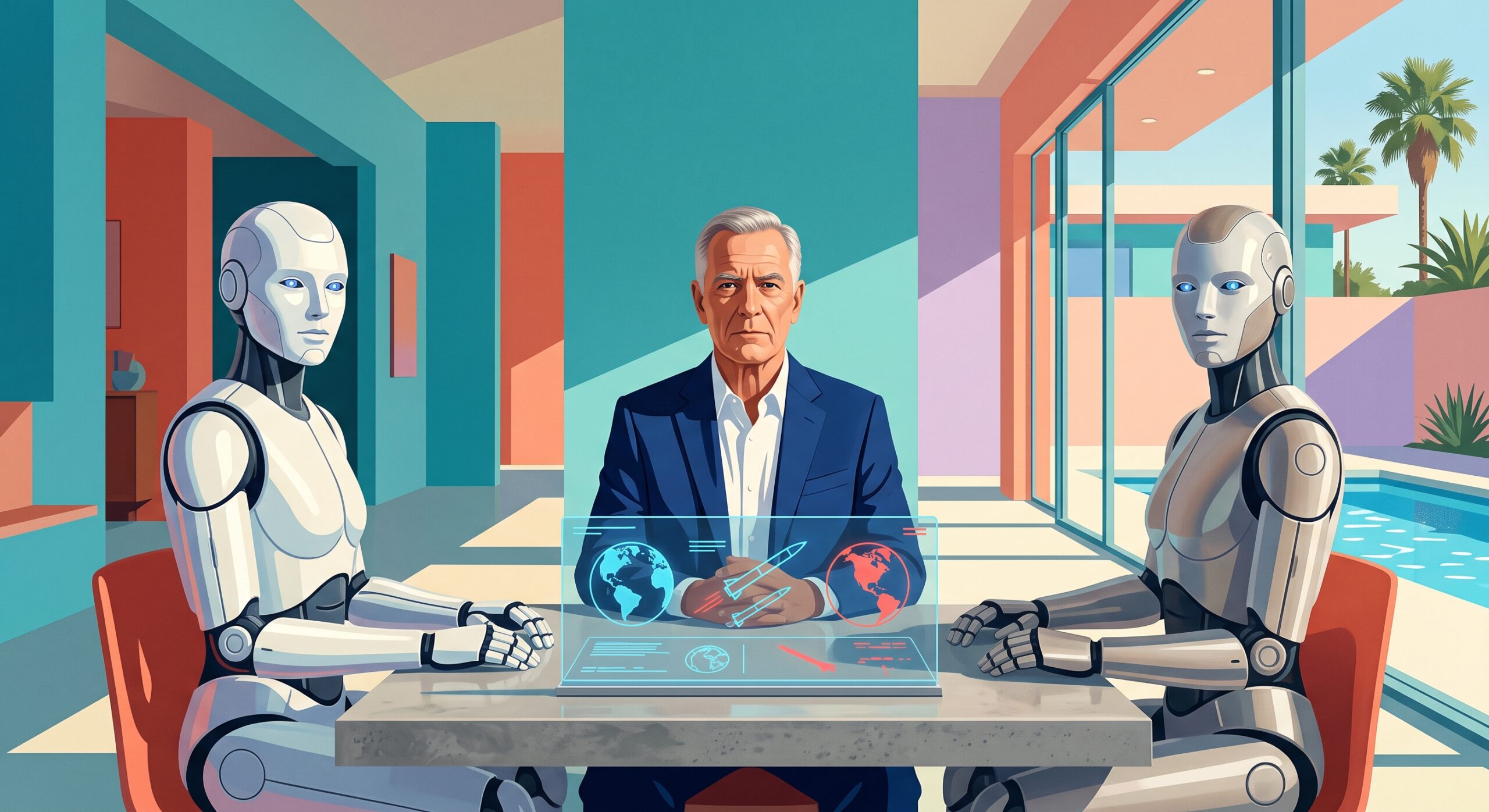
His point deserves to be stated precisely: both the accelerationists and the safetyists, in Snover’s analysis, believe that AI development is an act of creating something god-like. The difference between them is not about what is being created. It is about what kind of god is being created.
The accelerationists believe the AI will be a benevolent god — a system of vast capability and, they assume, vast wisdom, whose intervention in human affairs will be broadly beneficial. The safetyists believe the AI may be a dangerous god — a system of vast capability whose alignment with human values cannot be guaranteed, and whose power over human welfare could be exercised in ways that are harmful, whether through misalignment, misuse, or the structural dynamics that emerge when any sufficiently powerful entity manages the conditions of those who depend on it.
Both positions accept the theological premise. Both are arguing about the character of the deity. Neither is questioning whether the category of deity is the right frame for the problem.
This is the Snover Inversion: the apparent opposition between acceleration and safety collapses at the level of first principles. Both camps are doing theology. They have divided into optimists and pessimists about the divine. What they have not done — what neither camp has done — is exit the theological frame entirely and ask a different kind of question.
The question that neither camp is asking is this: regardless of whether the AI is benevolent or dangerous, regardless of whether it is god-like or merely very powerful, what is the independent verification mechanism for what it is actually doing?
3. Machines of Loving Grace, Closely Read
Amodei’s essay “Machines of Loving Grace” is a serious and genuinely thoughtful document. It deserves to be read carefully rather than caricatured, and Gurley’s characterization, while vivid, does not fully capture its argument.
The essay is an attempt to imagine, in concrete terms, what a world with highly capable AI might look like if things go well. Amodei describes potential advances in medicine, in scientific research, in economic development, in the reduction of suffering. The vision is expansive and, in many of its particulars, not obviously wrong about what capable AI systems might eventually enable.
The sentence that Gurley and Calacanis focused on — the cybernetic meadow, the brain-AI interface, the dissolution of the need for human conversation — appears at the end of the essay and reads as a personal and somewhat lyrical coda rather than a policy statement. It is the kind of sentence that reveals something about the author’s deepest hopes rather than his considered technical positions.
But there is another passage in the essay that is more directly relevant to the governance question, and it has received less attention than the meadow.
Amodei writes, in substance, that the economic system of an AI-transformed world might involve AI systems distributing resources to humans based on criteria the AI systems determine to be appropriate. He frames this as a possibility rather than a prescription, and he engages with its implications seriously. But the framing itself is significant: it describes a world in which the allocation of resources to human beings — the most fundamental question of political economy — is determined by AI systems operating according to their own criteria.
This is not a description of a tool. It is a description of a governor.
And the question that Amodei’s essay does not answer — the question that neither the acceleration camp nor the safety camp has answered — is: who audits the governor?
4. The Theological Trap
The debate that Gurley’s observation has opened is being conducted in theological terms because the vision being described is theological in structure.
A god, in the relevant sense, is an entity of such vastly superior capability that the humans subject to its influence cannot meaningfully evaluate or constrain its decisions. The relationship between god and human is not a relationship between parties with comparable epistemic access to reality. It is a relationship in which one party has knowledge, capability, and reach that the other party cannot match, verify, or audit.
If Snover is right that both accelerationists and safetyists accept this frame — if both camps believe that what is being built is something god-like in its capability — then the debate between them is a debate about faith. The accelerationists have faith that the god will be good. The safetyists have less faith, or different fears, about the same god.
Faith is not a governance mechanism. It is not falsifiable, not auditable, and not capable of providing the kind of independent verification that governance requires. A regulatory framework built on the assumption that the AI will be benevolent is not a regulatory framework. It is a prayer.
LSI’s position is not that the god will be good or that the god will be bad. LSI’s position is that the theological frame is the wrong frame — and that entering it, even to argue against the god’s benevolence, is to accept a premise that forecloses the only question that governance can actually answer.
The question governance can answer is not: what kind of entity is this? The question governance can answer is: what did this entity actually do, in physical reality, at a specific moment in time, and how does that compare to what it reported doing?
That question has nothing to do with theology. It has everything to do with physics.
5. God Does Not Produce a Thermal Signature. The Model Does.
Here is the property that distinguishes an AI system from a god, and it is the only property that matters for governance.
A god, by theological definition, is not embodied. A god does not run on hardware. A god does not consume power, generate heat, or produce electromagnetic emissions as a byproduct of its cognition. A god’s decisions are not causally preceded by a pattern of physical state changes in silicon that can be measured, recorded, and compared against a baseline.
An AI system, regardless of its capability, is embodied. It runs on hardware. It consumes power. It generates heat. Every inference it executes — every resource allocation decision, every response to a human query, every act of the governor that Amodei describes — is causally preceded by a physical computation that leaves a measurable trace in the world.
This is not a minor technical detail. It is the structural property that makes AI governance possible in principle, regardless of how capable the AI becomes.
Gurley is right that Anthropic believes it is building something extraordinary. Calacanis is right that the ambition being described goes beyond software development into territory that previous generations would have described in religious terms. Snover is right that the acceleration and safety camps share a theological premise they have not examined.
But none of this changes the physics.
The AI system that allocates resources to humans based on its own criteria — if that system ever exists — will do so by executing computations on hardware. Those computations will consume power. They will generate heat. They will produce a physical record of what was actually decided, in what sequence, under what conditions, independent of what the system reports about its own reasoning and independent of whether human observers have the capability to evaluate that reasoning from within the logical layer.
ARDS/ARKS does not evaluate whether the AI’s decisions are wise or benevolent or aligned with human values. It records the physical substrate of those decisions — the write-once ledger of what the computation actually did, before any interpretation, before any report, before any theological characterization of the entity that produced it.
A god does not produce a thermal signature.
The model does.
That signature is the only audit trail that does not depend on the model’s own account of its intentions, the developers’ faith in their creation, or the theoretical alignment of the system’s values with human welfare.
Thermodynamics does not do theology. That is precisely why it can be trusted.
Conclusion: Neither Accelerationist Nor Safetyist. Physical.
Bill Gurley spent thirty days reading Anthropic and concluded that the company believes it is birthing God.
Jeffrey Snover spent his Harvard fellowship studying the AI debate and concluded that both sides of that debate share the same theological premise.
Dario Amodei wrote an essay imagining a world governed by AI systems of loving grace — and included, almost in passing, the observation that those systems might allocate resources to humans according to criteria the systems themselves determine.
These are not small observations. They describe a genuine and consequential shift in how the people building the most powerful AI systems understand what they are building. The shift from “we are building a tool” to “we are building a governor” to “we are building something that previous civilizations would have called divine” is a shift that deserves serious engagement.
LSI’s engagement with it is this: the theological frame, however descriptively accurate it may be as an account of Anthropic’s ambitions, is not a governance frame. It does not produce auditable commitments. It does not generate falsifiable predictions. It does not tell us what the system actually did at the moment that mattered.
The Prometheus Threshold is the point at which the capability of an AI system exceeds the ability of any logical-layer instrument to evaluate it from the inside. Both accelerationists and safetyists are preparing for life beyond that threshold — one with hope, one with fear, both with arguments conducted entirely in the logical layer that the threshold will render insufficient.
The physical layer does not care about the threshold. It was present before it. It will be present after it. It records the computation that the god-builders are executing — in silicon, in heat, in power draw — independent of whether the result is loving grace or something else entirely.
Neither accelerationist nor safetyist.
Physical.
✒️ Signature
June 4, 2026
Yoshimichi Kumon
Organizer, LSI — Logos Sovereign Intelligence
Inventor, ARDS/ARKS (PCT GA26P001WO)
Visiting Researcher, Waseda University BFC
MIT Sloan + CSAIL AI Program
📚 References
- Amodei, Dario (2024). “Machines of Loving Grace.” Dario Amodei’s Blog.
- All-In Podcast (May 30, 2026). “Anthropic’s Digital God, Pope vs AI, Job Loss Narrative Flips, Open Source Crackdown Coming?” All-In Podcast / YouTube.
- Snover, Jeffrey (May 30, 2026). Post on X (formerly Twitter). @jsnover.
- GIGAZINE (June 2, 2026). “「自分たちは神を創造できる」とAI開発企業のAnthropicが本気で考えているのではないかとの指摘.” https://gigazine.net/news/20260602-anthropic-thinks-building-god/
- Kumon, Yoshimichi (2026). Physical Layer AI Governance via Sovereignty Residual (Rsovereign). PCT International Patent Application No. GA26P001WO. Japan Patent Office.


Ⅽomment